The short answer
A box fan with a MERV 13 filter can clean smoke particles well, and the EPA lists it as a cost-effective option. The multi-filter Corsi-Rosenthal box performs best. The catch is that DIY cleaners are loud, need fresh filters often, and have only been lab-tested with simulated smoke. A store-bought HEPA purifier is quieter and easier to size, but costs more.
What the EPA's lab tests found
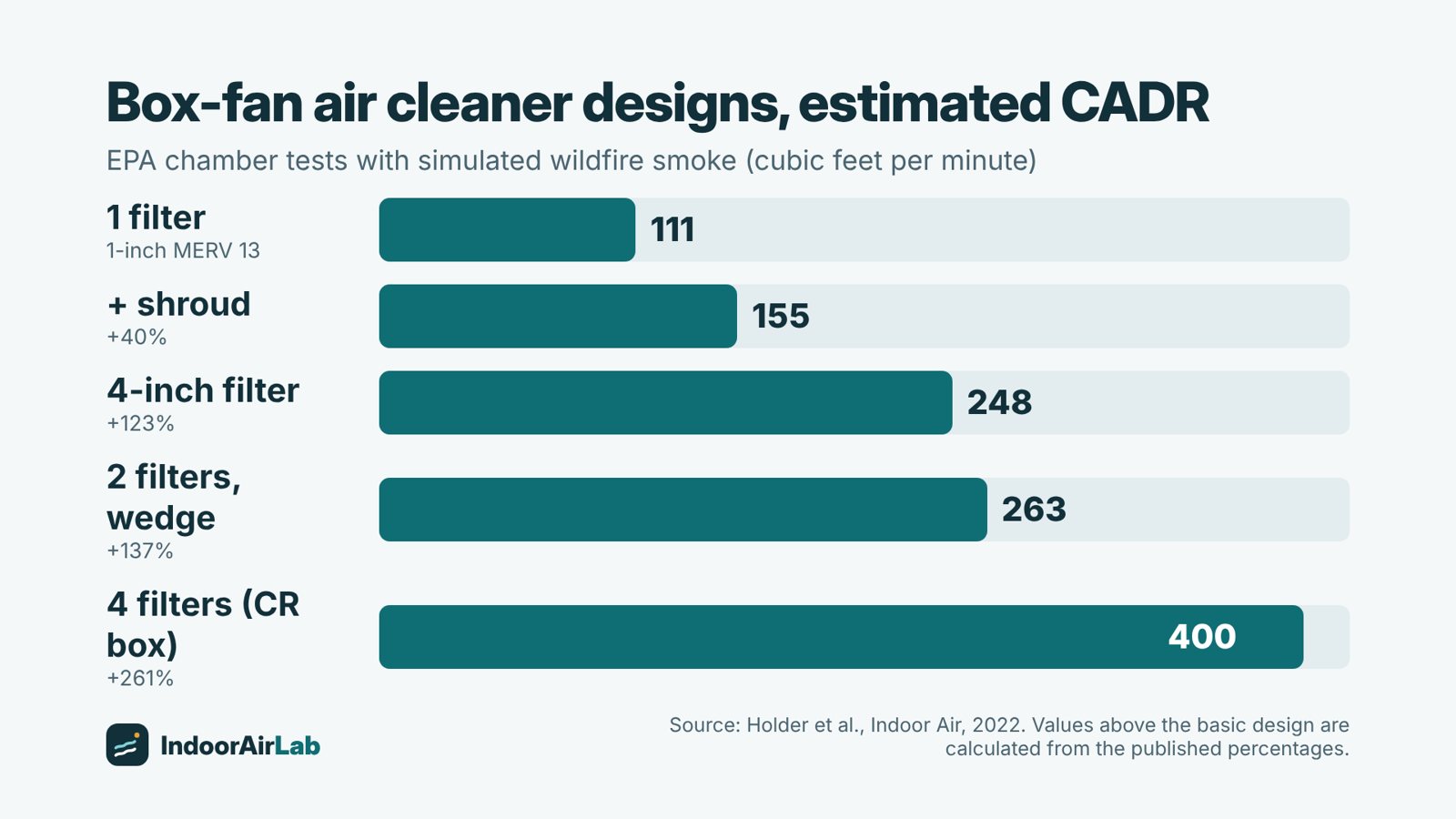
EPA researchers measured the CADR of several DIY designs in a room-sized chamber using simulated wildfire smoke made from smoldering pine needles (Holder et al., 2022, Indoor Air). The simplest design, a box fan with one taped-on 1-inch MERV 13 filter, measured about 111 CFM.
The study found large gains from small design changes:
| Design | CADR change vs. basic | Approx. CADR* | Largest room at the two-thirds rule* |
|---|---|---|---|
| Basic: fan + one 1-inch MERV 13 | baseline | 111 CFM | about 165 sq ft |
| Add a cardboard shroud | +40% | about 155 CFM | about 230 sq ft |
| Use a 4-inch thick filter | +123% | about 248 CFM | about 370 sq ft |
| Two filters in a wedge shape | +137% | about 263 CFM | about 395 sq ft |
| Four filters (Corsi-Rosenthal box) | +261% | about 400 CFM | about 600 sq ft |
*Our calculations from the published percentages. The two-thirds rule is the EPA and ENERGY STAR sizing guideline for certified purifiers. DIY CADRs were measured against simulated smoke in a lab chamber, not under the AHAM certification protocol, so treat the room sizes as rough estimates.
The big caveat: dirty filters
The same study found that CADR dropped sharply when filters were heavily loaded with smoke. The researchers pointed to a need for frequent filter changes during smoke events. EPA advice says to keep spare filters on hand and replace them when dirty. A box fan with a clogged filter does very little.
Safety
People worry that a box fan with a filter attached could overheat. EPA worked with Underwriters Laboratories to test five fan models, including an extreme case with the fan blocked for seven hours. EPA concluded that DIY cleaners built with newer fans are unlikely to pose a fire or burn risk, but should be kept clear of obstructions. EPA advises using only certified fans (UL or ETL marked, 2012 or newer).
Real-world evidence
Lab results are one thing; living with the device is another. In a 2021 EPA field pilot in Hoopa, California (six homes), both DIY and commercial cleaners were associated with lower indoor PM2.5. But the loudness of the DIY units discouraged people from running them, and the study was very small. A cleaner that stays switched off protects nobody.
DIY vs. store-bought
| DIY box-fan cleaner | Store-bought HEPA purifier | |
|---|---|---|
| Upfront cost | Low (EPA calls it cost-effective) | Higher |
| Particle removal | Strong with MERV 13, best with 4 to 5 filters | Strong; certified smoke CADR on the label |
| Noise | Loud, which affects how much people use it | Usually quieter, especially on low speeds |
| Sizing | Rough estimate only | Tested smoke CADR |
| Upkeep | Replace filters often during smoke | Replace filters on the manufacturer's schedule |
| Gases and odors | Not addressed | Some models add activated carbon |
Which should you choose?
- Tight budget or an emergency: build the DIY cleaner. Use a MERV 13 filter, the most filters you can manage, and keep extra on hand.
- You will run it every night or in a bedroom: a quiet purifier is easier to live with, and you are more likely to keep it on.
- Large room or odor concerns: a certified, correctly sized purifier is the more predictable choice. See our sizing guide.
What we will test next
We plan to measure PM2.5 reduction and noise for DIY and commercial units side by side. We will add the results here once we have them.
Sources
- Holder AL, Halliday HS, Virtaranta L. Impact of do-it-yourself air cleaner design on the reduction of simulated wildfire smoke in a controlled chamber environment. Indoor Air 32(11):e13163 (2022). pmc.ncbi.nlm.nih.gov
- U.S. EPA. Research on DIY air cleaners to reduce wildfire smoke indoors. epa.gov
- U.S. EPA. Impact of do-it-yourself and commercial air cleaner usage on health and residential PM2.5 (Hoopa pilot summary). assessments.epa.gov
- ENERGY STAR. An air cleaner can be helpful in high-risk wildfire areas. energystar.gov