The short answer
MERV is a 1-to-16 rating for how well an HVAC or furnace filter catches particles. Many home systems ship with a MERV 8 filter. The EPA suggests upgrading to MERV 13, or the highest rating your system can handle, and checking your HVAC manual or a technician first. Very high ratings like MERV 16 can restrict airflow in some home systems, so higher is not automatically better.
What MERV measures
MERV stands for minimum efficiency reporting value. It comes from the ASHRAE 52.2 test standard, which measures how much of three particle size ranges a filter captures:
- E1: 0.3 to 1.0 microns, the range that includes much of the fine particulate in smoke
- E2: 1.0 to 3.0 microns
- E3: 3.0 to 10.0 microns, which covers larger dust particles
A filter's MERV is set by the lowest efficiency it reaches in each range during testing.
The MERV table
| MERV | E1 (0.3 to 1 µm) | E2 (1 to 3 µm) | E3 (3 to 10 µm) | Typical use listed in the standard |
|---|---|---|---|---|
| 1 to 4 | not rated | not rated | under 20% | Minimum equipment protection |
| 8 | not rated | at least 20% | at least 70% | Common residential and commercial |
| 11 | at least 20% | at least 65% | at least 85% | Superior residential |
| 13 | at least 50% | at least 85% | at least 90% | Smoke removal, hospitals, superior commercial |
| 16 | at least 95% | at least 95% | at least 95% | Same applications as MERV 13 to 16 |
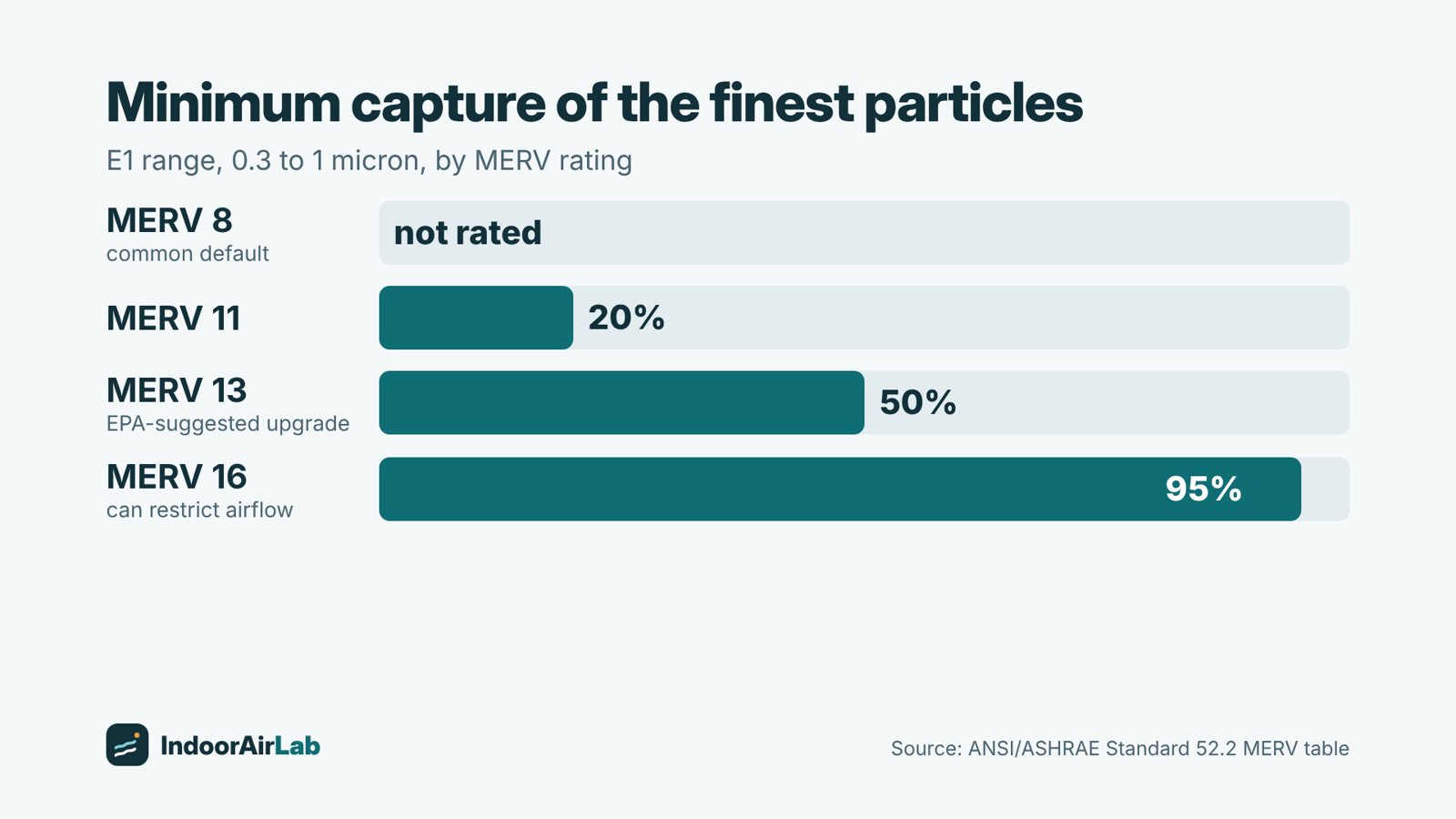
The jump that matters most for fine particles is between MERV 11 and MERV 13: the minimum E1 efficiency goes from 20% to 50%.
What the EPA recommends
The EPA's guidance on home HVAC filters says many systems use MERV 8 by default and suggests upgrading to MERV 13 or the best rating your system can accommodate. It also says to:
- Check your HVAC manual or ask a professional before changing filter types.
- Make sure the filter is seated correctly, so air does not bypass it.
- Run the system fan longer, or continuously if your system allows, because the filter only cleans air while the fan runs.
The EPA also notes that an upgraded filter alone is not a complete solution. For smoke events, a portable purifier in the room you use most adds protection (see Do air purifiers work for wildfire smoke?).
Can a high-MERV filter hurt your system?
This is the most common worry, and the research gives a nuanced answer. A 2013 study published in ASHRAE Transactions measured filters in ten California homes and ran energy simulations:
- MERV 10 to 13: In simulations, the effect on blower energy was moderate (under 5%) and negligible (under 1%) in most situations.
- MERV 16: Switching to MERV 16 roughly doubled the filter's pressure drop on average. Airflow fell by about 22% on average in systems with older PSC blower motors. Some homes had whistling noise, and two switched back to less restrictive filters.
The researchers noted the ten-home sample was small, so the numbers are indicative rather than precise. The practical takeaway: MERV 13 is usually a reasonable upgrade, while MERV 16 needs a system designed for it.
How to choose
- Standard home, no special concerns: MERV 8 to 11 is common. Check what your system's manual allows.
- Smoke, allergies, or pets: MERV 13, if your system can handle it.
- Thicker filters: A 4- or 5-inch filter has more surface area than a 1-inch filter at the same MERV, which generally means less restriction. Only use the thickness your filter slot is built for.
- Watch for signs of restriction: new whistling, weak airflow from vents, or a system that runs much longer than before. If you see these, step down a rating or call a technician.
How often to replace it
Follow your filter and system manufacturer's guidance, and check the filter monthly at first. Replace it sooner during smoke events, construction, or heavy pet shedding. A clogged filter cleans less air and adds strain on the system.
What we will test next
We plan to measure airflow and particle removal with different MERV ratings in a real home system and publish the method and results here.
Sources
- U.S. EPA. What kind of filter should I use in my home HVAC system? epa.gov
- ANSI/ASHRAE Standard 52.2, MERV table, as published by the National Air Filtration Association. nafahq.org
- Walker IS, Faulkner D, Dickerhoff DJ, Turner WJN. Energy implications of in-line filtration in California homes. ASHRAE Transactions 119(2) (2013). osti.gov